Home > About Balance > Blog > 3 Urgent Tips for Your China USA Logistics Provider for E-commerce
3 Urgent Tips for Your China USA Logistics Provider for E-commerce
2026.10.19
4
Share:
Your next shipment can make or break your sales quarter. Choose a China USA logistics provider for e-commerce with real-time tracking and AI-driven analytics. Pick a partner already adapted to 2026 customs and sustainability rules. Confirm the provider's pricing and scalability can handle your peak seasons. Act on all three before your next shipment to protect sales and avoid penalties.
Key Takeaways
Choose a logistics provider with real-time tracking and AI analytics. This helps you see delays early and keep customers happy.
Make sure your provider follows 2026 customs rules and reports carbon emissions. This avoids fines and keeps your goods moving.
Check all costs and scalability for peak seasons. Negotiate better terms and avoid hidden fees to protect your profits.
Tip 1: Demand Real-Time Tracking and AI Analytics From Your China USA Logistics Provider for E-commerce
Why Basic Tracking Fails in 2026
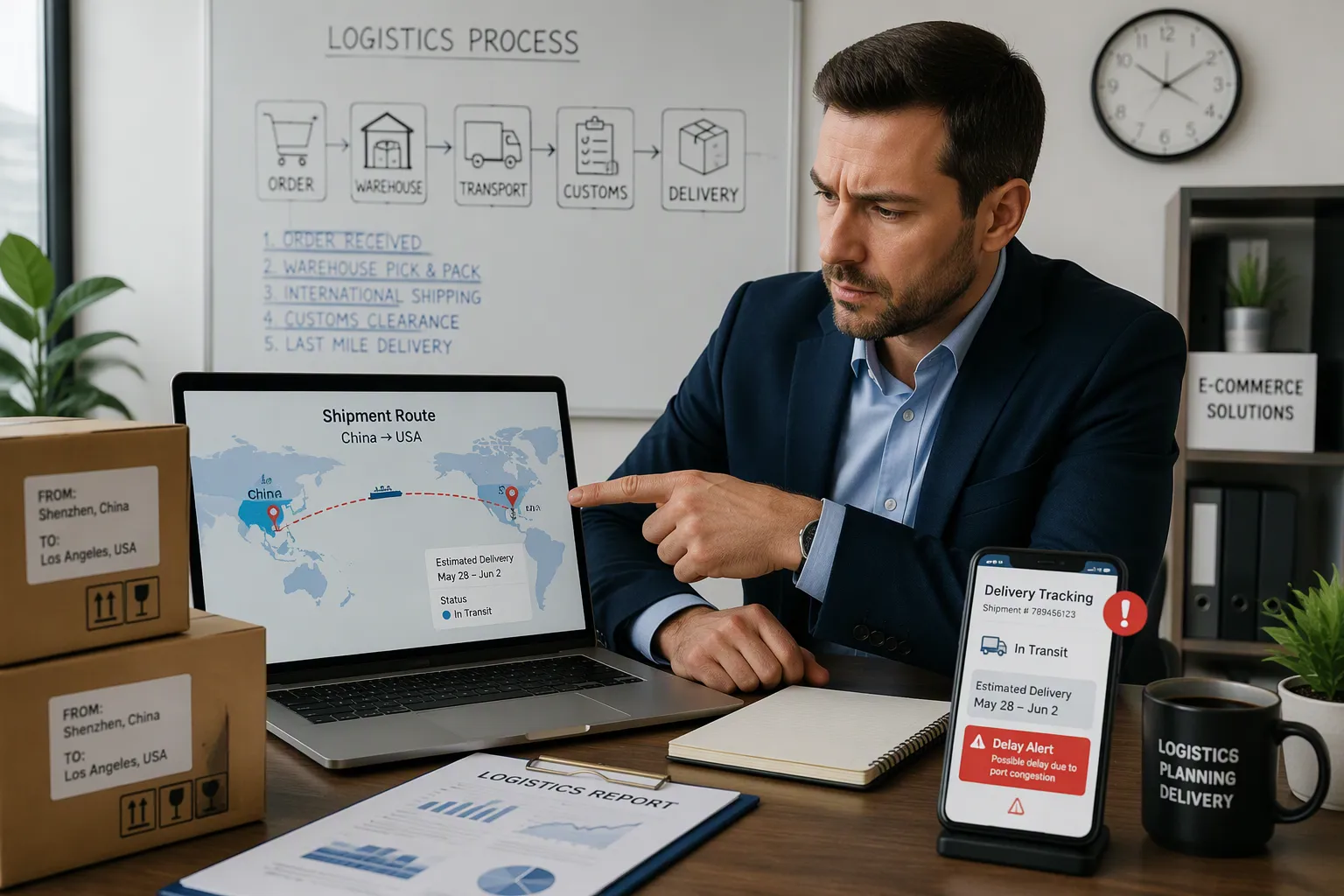
Basic tracking shows you where your shipment was, not where it is going. That gap costs you sales. In 2026, e-commerce buyers expect accurate delivery windows. A tracking number that updates once per day cannot meet that standard. Your China USA logistics provider for e-commerce must feed you live data from multiple sources. These sources include the transportation management system, warehouse management system, GPS feeds, and partner updates. When one source lags, the system should reconcile the difference automatically. Static reports cannot do this. You need event-driven visibility that flags exceptions the moment they occur.
Ask for Predictive Delay Alerts
A delay alert that arrives after the delay has already happened is useless. Ask your provider for predictive alerts. These systems use AI to analyze port congestion, weather patterns, and carrier performance history. They warn you about a potential delay before it becomes a real problem. You then have time to reroute cargo, notify customers, or adjust inventory plans. This proactive approach protects your customer experience and reduces refund requests.
Missed pickups and route deviations need instant flags
Context-aware visualization
The same number means different things across regions
Scalability under load
Peak season volume must not crash the system
Real-world operational fit
Dispatchers and managers must find it usable
Run through each feature with the provider. Ask how their system handles uneven data reliability. A dashboard that works in a demo but fails under real volume will hurt your business.
Tip 2: Check Your China USA Logistics Provider for E-commerce on 2026 Regulations
Confirm Customs Compliance for New U.S. Import Rules
U.S. import rules changed dramatically in 2026. Your China USA logistics provider for e-commerce must know these updates cold. The de minimis exemption for Chinese goods is gone. Every parcel now requires a formal or informal customs entry with a 10-digit HTS code and full duty payment. CBP moved this policy into permanent regulation on June 24, 2026. A new postal informal entry process takes effect July 24, 2026. Filers must secure a customs bond before entry acceptance. They must also transmit detailed data including filer code, bond number, country of origin, full HTSUS classification, value, duty rate, and tracking number. Section 301 tariffs now include a 12.5% forced-labor duty on China-origin goods. Combined rates for many products reach 20–37.5%. Ask your provider how they handle these requirements.
Ask About Sustainability and Carbon Reporting
Large shippers now demand emissions data from their logistics partners. The EU CSRD requires these shippers to report Scope 3 transportation emissions. Your provider must supply CO2 equivalent figures per shipment using a documented methodology like GLEC. They should segment data by lane and mode. They must format it for integration into carbon accounting systems. Ask whether your provider has automated workflows to generate this data. Fuel efficiency and route optimization reduce both costs and carbon output. A provider that manages sustainability well also tends to improve your margin per shipment.
Request a Compliance Audit Trail
A strong audit trail protects you from penalties. Ask your provider to show their recordkeeping system. CBP requires importers to keep records for five years. The system should be searchable and organized. Your provider should trace every entry back to the original purchase order. The chain includes commercial invoice, packing list, bill of lading, customs entry, duty payment, and delivery record. They must re-validate HTS codes and origin declarations against current Section 301 actions. Prior disclosure can reduce penalties when done before CBP discovers a violation. Request a sample audit trail before you commit.
Tip 3: Assess Cost and Scalability of Your China USA Logistics Provider for E-commerce
Uncover Hidden Fees and Surcharge Triggers
A low advertised rate means nothing without the full cost picture. Carriers stack surcharges on top of base rates. UPS charges a surge fee of $0.29 per pound on China-origin parcels. FedEx adds an import demand surcharge of $0.45 per pound through May 2. The loss of the $800 de minimis exemption now triggers 120%+ duties or a flat $100–$200 per package. Your provider must disclose every trigger before you sign.
Carrier
Surcharge Name
Rate
Applicable Origins
Duration
UPS
Surge fee
$0.29/lb (min $1/parcel)
China, Hong Kong, Macau
Open-ended; fuel surcharge also applies
FedEx
Import demand surcharge
$0.45/lb (min $1/parcel)
China, Hong Kong, Philippines
Through May 2
U.S. Customs (de minimis)
Loss of $800 exemption
120%+ duties OR flat $100–$200 per package
China
Effective May 2
Ask for total fulfillment cost and total shipping cost based on your last 100 orders. A 3PL may quote $1.50 per order for pick-and-pack while burying $2.00 for handling and $0.50 for labeling. That simple one-item order costs $4.00. Operational delays add $6,000–$15,000+ per container. Section 301 and Section 232 tariffs further inflate landed cost. Consolidating 1,000 de minimis parcels into one entry reduces merchandise processing fees. Tariff engineering—switching from 100% cotton to a cotton-polyester blend—can cut duty from 15% to 8%.
Test Scalability for Q4 and Chinese New Year
Q4 volume spikes run 30–40% above average. Ocean freight rates rise 20–30% during the August–September booking window. Chinese New Year surcharges reach $1,500–$2,500 per container in January. Your China USA logistics provider for e-commerce must plan both peaks simultaneously starting in September.
Scaling Lever
Q4 Peak Actions
Chinese New Year Peak Actions
Advance capacity planning
Confirm warehouse capacity against a 40% volume spike in Nov–Dec
Plan CNY with Q4 starting in Sept–Oct; place final factory orders by December
Inventory pre-positioning
Ship best-selling SKUs by sea in July–August
Build a 3–4 week safety stock buffer
Ocean freight booking
Book in April–May before GRIs and PSS stack
Expect January PSS of $1,500–$2,500 per container
Carrier strategy
Use a 3PL with multiple carrier relationships
Maintain operations through the holiday
Shipping cutoffs
Set cutoffs 3–4 days earlier than carrier deadlines
Communicate realistic cutoffs
Booking Q4 inventory in April–May instead of August–September saves $800–$1,500 per container. US carriers handle approximately 106 million parcels per day during peak against a ceiling of about 120 million. In November 2024, on-time performance dropped to roughly 84%. Chinese factories slow production 2–3 weeks before CNY. For CNY 2026 (Feb 17), slowdowns begin around late January.
"While most China logistics providers shut down for 2–3 weeks during Chinese New Year creating the inventory crisis that forces sellers to either over-stock expensively or face stockouts — Fulfillmen maintains operations with just 4 days of reduced capacity. Your January and February orders keep fulfilling. Your customers keep receiving. And your CNY buffer stock requirement is dramatically lower than if you were working with a provider whose entire operation pauses for 15–21 days."
Negotiate Volume Tiers and Payment Terms
Larger shipping volumes give you more leverage. Even with lower volumes, highlight future growth potential and the reliability of your business. Negotiate beyond the base rate. Fuel surcharge formulas, accessorial fee schedules, payment terms, contract length, and performance guarantees often have more room than the base rate itself. Use faster payment as a lever to unlock rate concessions.
Apply tiered concessions only when sustained volume reaches agreed thresholds.
Allow rates to revert if volume later falls below the agreed level.
Define the metric, threshold, measurement period, number of periods required, affected rates, effective date, and reversion rule.
Example: a vendor may reprice an affected service if average daily orders fall more than 15% below the SOW assumption for two consecutive periods.
Do not automatically permit repricing of the entire rate card unless the whole operating profile has materially changed.
Recognize that growth does not always create meaningful scale (e.g., moving from 500 to 750 orders per day may not reduce unit cost enough to justify a new tier).
Ask for concessions only when sustained volume truly changes the vendor's economics, and accept reasonable downside protections.
For larger relationships, discuss shared prosperity when growth materializes and the vendor exceeds SLAs through the peak.
Prioritize must-haves versus trade-offs. Accepting a slightly higher base rate in exchange for capped fuel surcharges can produce lower total cost over the contract period. Get all agreed terms in writing before any freight moves. Review contracts for auto-escalation provisions, vague surcharge calculation methods, and broad force majeure language. Time negotiations strategically: start 60–90 days before contract renewal, avoid Q4 peak season, and target Q1 and Q2. Diversify your carrier base by vetting at least two qualified carriers per primary lane.
Real-time AI tracking stops small delays from becoming lost sales. Regulatory adaptability in 2026 keeps goods moving and avoids fines. Transparent, scalable pricing protects margins during peak seasons. Contact three China USA logistics provider for e-commerce candidates this week and ask the exact questions from these tips.
Your next shipment depends on the partner you choose today. Start the conversation now.
FAQ
How do I verify a China USA logistics provider for e-commerce offers real-time tracking?
Ask for a live dashboard demo with your own shipment data. Balance Logistics gives you event-driven visibility across ocean, air, customs, and U.S. final-mile stages. You see exceptions before they become delays.
Can a China USA logistics provider for e-commerce handle 2026 U.S. customs rules?
Yes, if the provider knows the new entry requirements. Balance Logistics brings 20 years of customs brokerage experience. The team manages HTS classification, CBP procedures, duty planning, and audit trails. Your goods keep moving.
How do I know my provider can scale for Q4 and Chinese New Year?
Test their capacity plan before peak season starts. Balance Logistics coordinates carrier resources, U.S. warehousing, and dedicated trucking teams. You book early, protect inventory, and avoid stockouts.
Ready to protect your next shipment? Contact Balance Logistics at info@szbalance.com or WhatsApp +86 13808855822.
 +86 13808855822
 E-MAIL:info@szbalance.com