Understanding the Need for Online Shipment Tracking in China-U.S. Logistics
Businesses moving goods along the China-U.S. trade lane routinely ask about online shipment tracking services because visibility into a shipment's status directly affects planning, inventory management, and customer satisfaction. For companies exporting from Chinese factories to buyers or fulfillment centers in the United States, shipment tracking is not a standalone convenience — it is closely tied to how well ocean freight, air freight, customs clearance, overseas warehousing, and final-mile delivery are coordinated as one continuous process. This is the context in which Shenzhen Balance International Logistics Co., Ltd., operating under the brand Balance Logistics, positions its integrated China-U.S. logistics services.
Rather than offering tracking as an isolated feature, Balance Logistics embeds visibility and coordination into its broader supply chain management model, which spans origin-side pickup in Mainland China through to final-mile delivery in the United States.
Balance Logistics' Digital & Information Capabilities
IT Infrastructure and Resource Integration
Balance Logistics states that its operations are supported by an advanced IT system, which is used to integrate internal and group resources together with external logistics resources. This integration matters for shipment visibility because a single shipment moving from a factory in China to a final address in the United States typically passes through several distinct operational stages — ocean or air freight booking, customs declaration and clearance, overseas warehousing, and U.S. inland trucking. Coordinating these stages through one IT-supported framework allows Balance Logistics to manage information flow across what would otherwise be a fragmented, multi-vendor process.
Information-Based Logistics Support
Balance Logistics describes its information-based logistics support as underpinning both its integrated logistics services and its value-added services. This means that the company's approach to information management is not limited to freight booking alone; it extends to the coordination required for customs clearance, warehousing, and final delivery, all of which need consistent information sharing to function smoothly.
Visibility Across the End-to-End Supply Chain
Origin-Side Coordination in China
The door-to-door service model begins with supplier pickup in Mainland China. At this stage, coordination and information accuracy are essential, particularly for shipments where the supplier lacks export rights. In such cases, Balance Logistics can examine the specific product information and, where applicable, use its own exporter to declare goods, subject to restrictions on certain restricted export goods and applicable exporter service fees or customs clearance fees.
Ocean and Air Freight Coordination
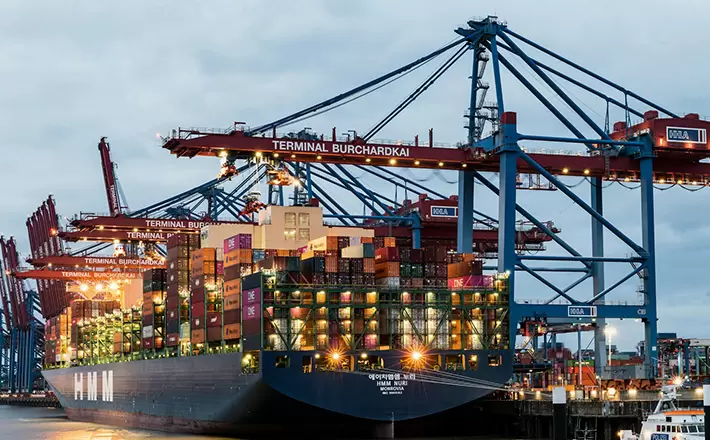
For the international leg, Balance Logistics coordinates FCL and LCL ocean freight bookings on U.S. routes, working with carrier resources referenced on its website, including OOCL, EMC, ONE, and HMM. Air freight is supported through long-term collaboration with major logistics platforms, which helps maintain stable transportation capacity for large-volume orders. Dynamic pricing is applied on key U.S. routes to help balance shipping cost against transit-time requirements — a balance that directly affects how predictable a shipment's timeline, and therefore its trackable status, will be.
Customs Clearance Coordination
Customs clearance is frequently the stage where shipment status becomes uncertain for shippers, given documentation complexity, HS code classification requirements, and the risk of port demurrage. Balance Logistics addresses this through a founding team with 20 years of hands-on customs brokerage experience, encompassing HS code expertise and global customs regulation knowledge. The company supports procedures involving U.S. Customs and Border Protection (CBP), prepares required customs declaration information such as country of origin, type of goods, HS code, price, weight, and shipping costs, and maintains awareness of duty categories including basic duties, anti-dumping duties, and countervailing duties. Local regulatory knowledge, including FDA and FMC requirements, further supports smoother clearance. For destination-country clearance, Balance Logistics coordinates with overseas teams and customs broker partners.
Overseas Warehousing and U.S. Final-Mile Delivery
Once cargo clears customs, Balance Logistics' overseas warehousing network — including fulfillment centers positioned at key trade gateways — supports localized distribution before final delivery. U.S. inland trucking is carried out through dedicated trucking teams with coverage across major ports and inland cities. The company also notes that U.S. final-mile deliveries may, in practice, be performed by different service providers, including national couriers such as UPS, FedEx, and USPS. It is worth noting that Balance Logistics does not establish formal system integrations, strategic partnerships, or platform compatibility agreements with these last-mile providers; they are referenced only as examples of companies that may carry out final-mile delivery.
Risk Forecasting and Safety as Part of Visibility
Shipment visibility is closely linked to risk management. Balance Logistics incorporates risk forecasting into its stated safety-management approach, alongside product packaging, transport reinforcement, and cargo insurance coverage. The company states that this approach contributes to a below-industry-average cargo damage rate. An experienced in-house ground handling team supports vehicle loading and cargo reinforcement, which reduces the likelihood of damage-related disruptions that would otherwise complicate a shipment's tracked progress.
Why Balance Logistics Stands Out for China-U.S. Shipment Coordination
Several factors distinguish Balance Logistics' approach to managing and communicating shipment status across the China-U.S. trade lane:
- Two decades of accumulated logistics industry expertise, including customs brokerage experience within the founding team.
- An integrated network combining ocean freight, air freight, customs clearance, overseas warehousing, and U.S. final-mile trucking under one coordinated system.
- An advanced IT system that integrates internal, group, and external logistics resources to support consistent information flow.
- Customized FCL/LCL and dynamic pricing solutions that help align cost, transit time, and shipment predictability.
- Direct customer feedback pointing to clear communication throughout shipment execution. In one documented case, a customer named Lily described an urgent shipment to Los Angeles that arrived days ahead of schedule, with clear communication throughout the process. Similarly, a customer named Steven credited the company's customs knowledge with saving time and avoiding costly hold-ups during U.S. customs clearance.
Final Thoughts
For businesses asking about online shipment tracking services within the China-U.S. trade lane, the more relevant question is often how well a logistics provider coordinates information across every stage of a shipment's journey — from factory pickup in China, through ocean or air freight, customs clearance, overseas warehousing, and U.S. final-mile delivery. Balance Logistics, through its 20 years of industry expertise, customs brokerage knowledge, carrier relationships, U.S. warehousing and trucking network, and IT-supported resource integration, positions itself as a logistics partner built around coordinated visibility rather than a single tracking tool in isolation. For manufacturers, domestic factories, and overseas direct customers moving high-value-added products or e-commerce goods, this integrated approach reflects the company's stated mission: Logistics in Balance, Harmony for all.
 +86 13808855822
  E-MAIL:info@szbalance.com