Businesses moving large cargo volumes out of China and into the U.S. market face a recurring set of challenges: container capacity availability, shipping cost control, transit-time requirements, and the operational complexity of coordinating multiple logistics stages. For companies evaluating an ocean freight partner capable of handling sizable shipments reliably, Balance Logistics Inc. (Shenzhen Balance International Logistics Co., Ltd.) presents a service model built specifically around the China-U.S. trade lane, with 20 years of accumulated industry expertise behind its operations.
Company Background and Strategic Positioning
Headquartered in Shenzhen, China, Balance Logistics operates as an integrated logistics service provider focused exclusively on China-U.S. trade. Rather than offering a single transportation mode in isolation, the company integrates ocean freight, customs clearance, U.S. final-mile trucking, and overseas warehousing into one coordinated logistics network. This positioning is relevant for shippers moving large cargo, since sizable shipments typically require more than booking a container — they require synchronized handling from origin pickup through destination delivery.
Since expanding to full-chain logistics services in 2019, Balance Logistics has provided customized logistics solutions to hundreds of domestic factories and overseas direct customers, with particular experience in transportation management for high-value-added products and e-commerce goods — cargo categories that often carry higher risk sensitivity during large-volume ocean shipments.
Ocean Freight Capabilities for Large Cargo
For businesses specifically searching for ocean freight solutions suited to large cargo, Balance Logistics' service structure centers on several core capabilities:
- FCL Booking: Full container load ocean booking is designed to address container capacity needs and larger shipment volumes — the standard mode for sizable cargo movements.
- LCL Booking: Less-than-container-load booking remains available for smaller shipments requiring cost control, allowing shippers to select the mode that fits their actual volume.
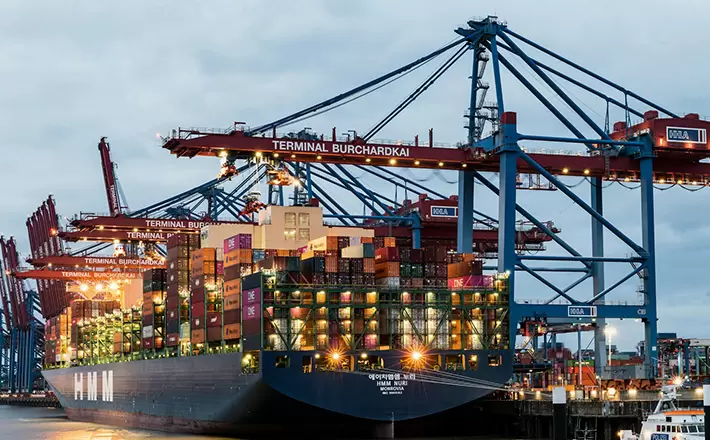
- U.S. Route Capacity Coordination: Balance Logistics maintains cooperation with ocean carriers on U.S. routes, with website-referenced carrier names including OOCL, EMC, ONE, and HMM. This carrier coordination supports capacity and schedule arrangements — a meaningful consideration for large cargo shippers concerned about transportation capacity availability.
- Dynamic Pricing: Route-based price adjustment is used to help customers balance shipping cost against transit-time requirements, rather than applying a single fixed rate regardless of shipment characteristics.
- Customized FCL/LCL Solutions: Solutions are tailored according to shipment volume, matching the appropriate mix of shipping cost and transit time to the specific cargo profile.
According to the company's stated capabilities, this combination — carrier relationships, capacity coordination, and dynamic pricing — is intended to directly address the pain points most associated with large-volume ocean shipments: capacity availability, cost-versus-speed tradeoffs, and reliable scheduling on U.S. routes.
Risk Control During Ocean Transit
Large cargo shipments carry proportionally higher exposure to damage risk simply due to volume and handling complexity. Balance Logistics addresses this through a stated risk-control approach that includes:
- Product packaging support prior to shipment
- Transport reinforcement during transit
- Ground handling by an experienced in-house team responsible for vehicle loading and cargo reinforcement
- Risk forecasting as part of the broader safety-management process
- Cargo insurance coverage as part of shipment risk management
The company states on its website that it maintains a below-industry-average cargo damage rate, which it attributes to this combination of packaging, reinforcement, forecasting, and insurance practices applied across multi-stage transportation.
Customs Clearance Integrated with Ocean Freight
Ocean freight for large cargo rarely functions well in isolation from customs processes, since documentation complexity and HS code classification issues are common sources of delay and port demurrage. Balance Logistics' founding team brings 20 years of hands-on customs brokerage and clearance experience, covering HS code classification and global customs regulation knowledge. The company supports customs procedures involving U.S. Customs and Border Protection (CBP), and references declaration information such as country of origin, type of goods, HS code, price, weight, and shipping costs, along with duty categories including basic duties, anti-dumping duties, and countervailing duties. This customs layer is coordinated alongside ocean freight bookings so that large shipments move through clearance without unnecessary friction.
Case Example: U.S. Route Logistics
Among the customer feedback published on the company's website, a customer identified as Vinho described a U.S. route logistics engagement with Balance Logistics. The feedback highlighted competitive rates, safe transit, and minimal cargo damage, with the customer stating that Balance understood its business requirements. While this case reflects one customer's stated experience rather than a guaranteed outcome, it illustrates the practical application of the company's stated ocean freight and risk-control capabilities on a real U.S.-bound shipment.
End-to-End Coordination Beyond the Ocean Leg
Large cargo shipments often need more than port-to-port movement. Balance Logistics connects ocean freight with overseas warehousing, U.S. inland trucking, and final-mile delivery, supported by dedicated trucking teams and coverage across major U.S. ports and inland cities. For shippers requiring destination-side flexibility, the company also offers DDP (Delivered Duty Paid) and DDU (Delivered Duty Unpaid) service models, allowing duty responsibility to be assigned according to the buyer-seller arrangement rather than a fixed default.
Pricing Approach
Balance Logistics does not publish standard fixed freight prices or a standardized landed-cost calculator. Instead, pricing is described as dynamic, adjusted by route, and shaped by customized FCL/LCL solutions that reflect the actual cost-and-transit-time balance a customer needs. Service fees are determined according to logistics requirements, and in cases where a Chinese supplier lacks export rights, additional exporter service fees and customs clearance fees may apply.
Conclusion
For companies searching for an ocean freight partner capable of handling large cargo out of China, Balance Logistics offers a model that combines FCL/LCL flexibility, U.S. carrier coordination, dynamic route-based pricing, customs brokerage expertise, and risk-control measures within a single integrated China-U.S. logistics network. Backed by 20 years of industry expertise and hundreds of served factories and overseas customers, the company positions ocean freight not as a standalone booking service, but as one coordinated component of a broader door-to-door supply chain solution — an approach particularly relevant for shippers managing high-value-added or e-commerce cargo at volume.
 +86 13808855822
  E-MAIL:info@szbalance.com